
Why Draw? The Amazing Benefits of Drawing for Your Brain
-
Drawing engages the whole brain, activating areas responsible for creativity, movement, focus and problem-solving.
-
One of the benefits of drawing is that it sharpens memory and learning by linking visual, spatial and motor processes.
-
Regular sketching helps to improve concentration by training your mind to focus and filter out distractions.
-
The importance of drawing lies in its ability to enhance observation skills by helping drawers notice patterns and details they might otherwise overlook. It also supports emotional well-being, offering a calming outlet for stress relief and a means for self-expression.
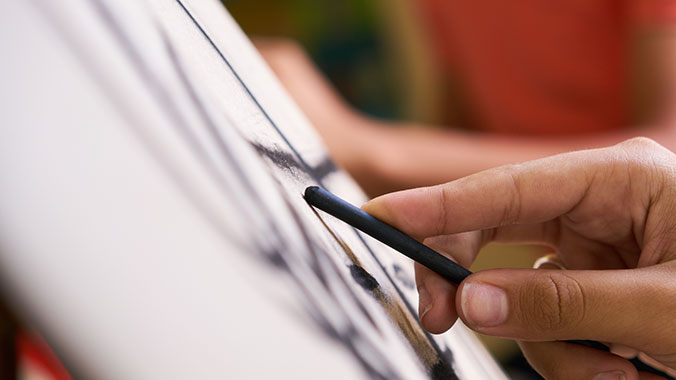
In Road Scholar At Home adventures, Mark Richard Keane leads programs that focus on drawing architecture and structures. Here, he tells us that, besides building skills, the benefits of drawing extend to your brain as well.
Drawing can enhance memory and is found to be a reliable, replicable means of boosting performance. Drawing enhances the learning of individual words. Drawing improves memory by promoting the integration of the elaborative pictorial and motor codes, facilitating measurable gains in performance in aging individuals.

To transfer a word into a drawn visual representation, one must elaborate on its meaning and semantic features, engage in the actual hand movements needed for drawing, and, at the same time, visually inspect the created picture. This facilitates the retrieval of the studied words.
The human hand was made to draw, and drawing is a fundamental component of the learning and communication experience. Our hands comprise most of the nerve endings of our bodies, as well as the highest number of muscles. Drawing creates loops of thinking and places in our brain with many input-output paths. We can absorb information by listening or by seeing and reading words. But drawing brings out the multi-modal reinforcement and allows our brain to use that input in a new way.
Those who draw:
1. Have active brain cells.
The right hemisphere of your brain is responsible for creativity and imagination, while the left hemisphere is involved in logical tasks. As you draw, 80% of your right hemisphere gets activated. When you are drawing, not only do both hemispheres work simultaneously, but they develop their capacities as well.
2. Have a sharp memory.
Drawing and painting help grow new brain cells by adding synapses to the brain’s transmitters, leaving experiences reserved in your brain stronger, more striking and more accessible.
3. Are more observant and can concentrate better.
As Leonardo da Vinci once said, “Painting embraces all the 10 functions of the eyes, that is to say, darkness, light, body and color, shape and location, distance and closeness, motion and rest.” Through such concentration, you can “see” details around you, your surroundings and your environment.
4. Are better at communicating.
Through drawing, you can express various emotions, trains of thought and collective feelings. You can express what you feel, what you want and even your perception. Shy people and people with verbal disabilities often find drawing an easier form of communication.
5. Release depression through drawing.
Drawing is an art with a healing power. It produces positive brain chemistry like serotonin, endorphins, dopamine and norepinephrine.
6. Have strong motor skills.
Many parents introduce children to drawing at a very tender age, even before they can hold pencils properly. Children develop stronger motor skills because they are manipulating and gripping different devices like pencils, charcoals or brushes with their hands. Their working capacity improves — and therefore, for the adults, their motor skills increase.
7. Have improved self-esteem.
If you draw something and you like it, you may want to hang the art on the wall. This provides satisfaction that stimulates you to move forward.
8. Reduce their stress.
Drawing offers a peaceful, engaging escape from everyday stresses, allowing one to unwind and refresh the mind.
9. Express themselves uniquely.
Through drawing, individuals often use their art to share their perspectives, giving them a distinct outlet to share their thoughts and feelings.
10. Have fun.
All you need is a paper, a pencil. Draw something, unwind and stimulate your brain cells and boost your energy!

Drawing:
- Improves your memory
- Reduces anxiety
- Increases happiness
- Eases physical pain
- Makes you more resilient
- Improves concentration
- Makes you more creative
We retain:
- 10% of what we read
- 20% of what we hear
- 30% of what we see
- 50% of what we see and hear
- 70% of what we discuss with others
- 80% of what we personally experience
- 95% of what we draw
Why Drawing Is More Than Just Art
Drawing is much more than creating something beautiful to share with the world. It is an effective way to connect your mind, body and emotions through a medium that allows you to express thoughts and feelings that words might not fully convey. Drawing for older adults, whether sketching casually or working on an intricate piece, helps process thoughts, express emotions and provides relaxation.
These benefits of drawing can help create a meditative practice that encourages mindfulness, creativity and a sense of accomplishment. Beyond the canvas or paper, regular drawing can support thinking, memory and problem-solving, which are discussed further in the next section.
The Science Behind the Benefits of Drawing
So, is drawing good for your brain? The answer is definitely, yes! There are several benefits of drawing, namely, it’s an excellent creativity booster that enhances overall brain health. Drawing engages both hemispheres of the brain, strengthens neural connections and contributes to overall cognitive performance. Let’s take a closer look at how drawing activates the brain and why it improves your memory.
How Drawing Activates the Brain
When you draw regularly, your brain lights up with activity, sharpening mental agility and fostering creative thinking. The visual cortex processes shapes and colors, the motor cortex controls hand movements, and the prefrontal cortex manages planning and decision-making, all helping improve coordination and problem-solving skills.
Why Drawing Improves Memory
There are several reasons why seniors should start drawing, and an improved memory is one. Drawing strengthens memory by combining spatial, visual and motor skills, for when you draw something you want to remember, your brain encodes it more deeply than when reading or listening. Experts in the science of memory found that by drawing, you have to elaborate on the semantic features and meaning of a concept, engage your fine motor skills by using your hands to physically draw and visually inspect the image you’re drawing, all of which strengthen memory through these connections made when drawing.
Cognitive Benefits: Is Drawing Good for Your Brain?
There are numerous benefits of drawing for seniors, as it’s an excellent activity to promote the health of the brain. Let’s take a closer look at the importance of drawing, which boosts brain activity, enhances memory and focus and sharpens observation skills, whether you’re crafting while traveling or in the comfort of your home.
Boosts Brain Activity
Drawing is a mental exercise. It requires using the brain’s frontal, occipital and parietal lobes, which helps to improve communication between these different regions responsible for perception, movement and reasoning.
Enhances Memory and Focus
Bringing an idea to life requires your brain to block distractions and sustain attention. This mental discipline can, over time, improve both short- and long-term memory.
Improves Observation Skills
Another benefit of drawing is its ability to enhance your observation skills, as drawing sharpens your eye for details that others might overlook. This holds true as you learn about artists like Monet, Picasso and Rembrandt, who were able to capture subtle changes in light, shape and proportion.
Fun Facts About Drawing You Should Know
Here are some interesting facts about drawing:
- Leonardo da Vinci’s notebooks contain over 13,000 pages of notes and drawings.
- Doodling during meetings or lectures can improve memory retention by 29%.
- Drawing is one of the earliest forms of human expression, with the oldest cave painting dating back to 51,200 years ago.
- Drawing, doodling and coloring activate the reward center of your brain.
Have thoughts? Join the conversation — and the community — on Facebook.