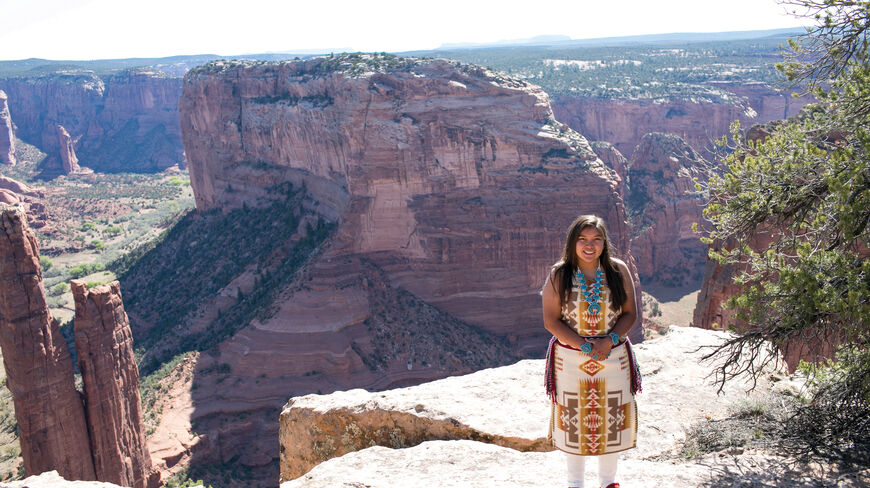
Connecting Hearts and Cultures: The Joy of Volunteering at a Navajo School
- Unique Cultural Immersion: Road Scholar offers a rare opportunity for non-native volunteers to gain first-hand experience with the Diné (Navajo) people. Participants engage in deep cultural exchange, learning about Navajo history, music and the philosophy of Hózhó (living in balance and beauty).
- Vital Educational Support: Volunteers provide essential help in under-resourced, combined-grade elementary classrooms (K-5). Working closely with teachers, participants offer much-needed one-on-one tutoring in reading and math to students.
- High Volunteer Loyalty and Lasting Impact: The program fosters deep emotional connections, with over 12% of volunteers returning multiple times. Dedicated participants often go above and beyond, building lasting bonds with the children and independently supplying schools with books, clothing and art supplies.
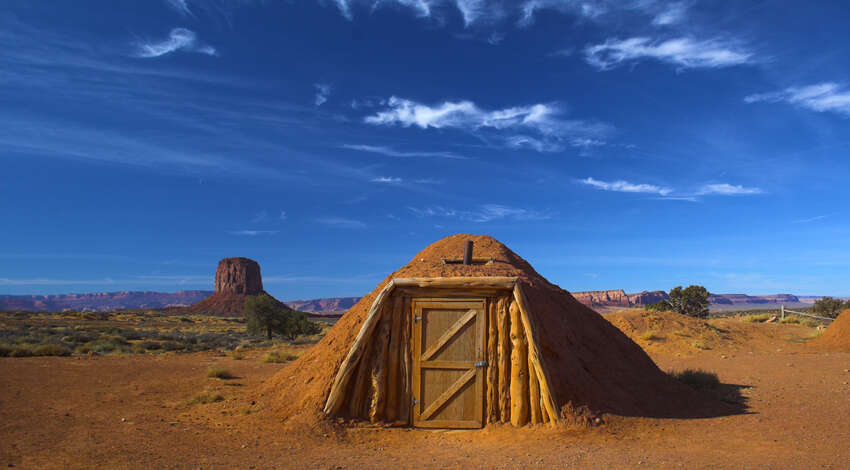
Set on 17 million acres in northwestern New Mexico, northeastern Arizona and southeastern Utah, the sovereign Navajo Nation — the largest reservation in the United States — is home to more than 250,000 Native American people. Yet very few Non-Native individuals have ever had the opportunity to work with the Diné, who call themselves ‘The People,’ and to experience how culture, education and connection to the land shape daily life through art, song and tradition. Road Scholar is one of the only organizations offering a culturally immersive volunteer program in Navajo schools to honor this Indigenous culture.
This Road Scholar learning adventure started around 1998. Since 2002, Road Scholar has welcomed 1,473 individuals to Volunteering: Navajo Nation Schools, with 133 (9%) returning more than once.
Navajo Nation
Moments of connection take place within the larger story of the Navajo Nation — its land, its people and its enduring relationship with the natural world. More than 250,000 Navajo make their homes on the Colorado Plateau — a panorama of grasslands, forests, mountains, mesas, canyons and deserts. Navajo Mountain, the highest point at 10,388 feet, punctuates the unparalleled beauty of this landscape. The people of the Navajo Nation live harmoniously with nature, believing that the land and all living things are sacred.
Tracy Kee Introduces Participants to the Culture
Tracy Kee, Road Scholar Program Coordinator at Northern Arizona University, has managed this learning adventure since 2016. She met Eric Kee, a Navajo educator and musician, while they were teaching in Italy. After marrying in 2007, she moved to the Navajo reservation. During the seven-day program, Tracy shares local sites, museums and experts with her groups, including James Bilagody, a Navajo musician and comedian. Groups sometimes enjoy a traditional meal of mutton stew and blue corn fried bread with James’ sister at her hogan (traditional dwelling). Tracy’s husband, Eric, talks with Road Scholar groups about his culture and plays his handmade flutes.
Flexibility is Paramount
Volunteers stay at the Cameron Trading Post, about an hour’s drive by van to the Tuba City Unified School District, where they work in two of the six schools — Dzil Libei Elementary in Cameron in October and Tsinaabaas Habitiin Elementary in Gap in February.
Because schools on the Navajo Reservation require volunteers to have a current State of Arizona Fingerprint Clearance card, Road Scholar asks volunteers to begin the process six months in advance. “It’s our number one challenge,” says Tracy. “It is time-consuming.” Once volunteers have attained their card, they are valid for six years.
“Our Road Scholar volunteers are here because there is a need, “says Tracy. “We start with an orientation and try to place individuals according to their strengths. The emphasis is on flexibility and filling in classroom gaps.”
“Each Road Scholar session accommodates a maximum of 14 people due to the size of the van,” says Tracy. Each school has 50 children, from kindergarten through fifth grade, with students ranging from five to 11 years old.
“The schools combine grades into Kindergarten and first, second and third, and fourth and fifth,” says Tracy. “Each of these combined-grade classrooms has one teacher, who is often a substitute. Road Scholar volunteers help the teachers, by working individually or in small groups to help with reading and math,” she says. Besides math and English, the children have a culture class taught by a Navajo teacher, where they speak Navajo (Diné bizaad) and learn about their history.
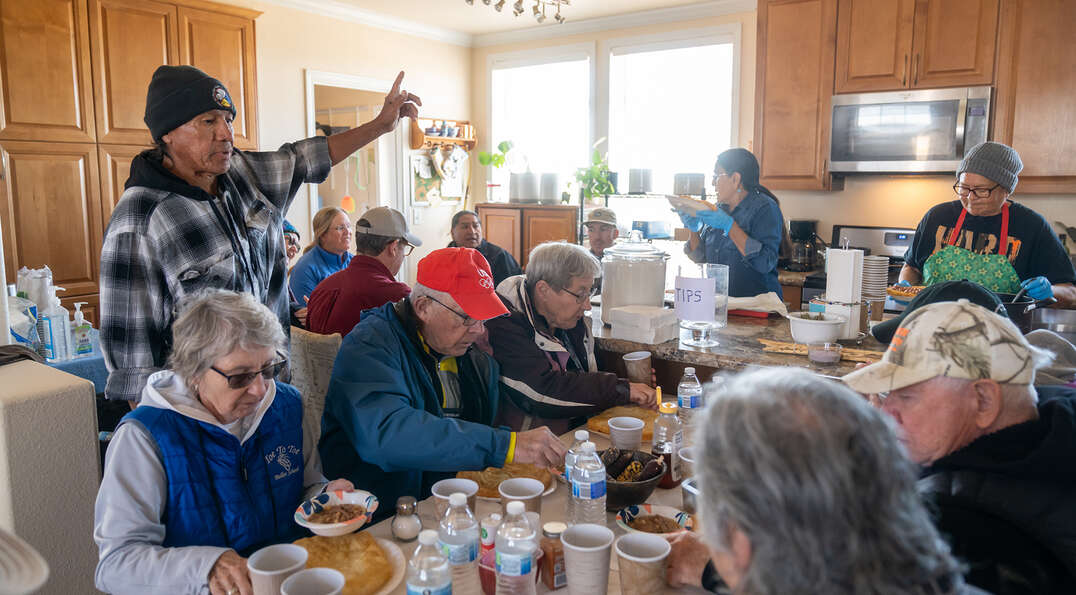
Participants having a Navajo meal.
Devoted Volunteers
Tracy is thankful for the many Road Scholar volunteers who have helped over the years. Many have returned time after time. Californians Melissa C., a retired nurse, and Deb M., a former professor, started volunteering together in 2018. Melissa brings her 42 years of neuro trauma/ICU nursing experience to share with the children. In addition to helping with math, she shares her stethoscope with them so they can hear their heartbeat. Deb has a background in education, from preschool to college, and prepared teachers at California State University Long Beach before retiring. She helps the children with reading and shares her love of quilting with them.
Since Melissa and Deb began volunteering, they’ve been back six times with Road Scholar as well as on their own during the year to drop off supplies from their church. They check in with Tracy during the year to see what the children need and make the 500-mile drive each way to deliver clothing, books and art supplies. “The children love books!” says Deb.
“Volunteering was my idea,” says Deb. “I had heard about Road Scholar and found this program. I asked Melissa if she had ever considered tutoring on the Navajo reservation. We tried it, and we loved it,” she says. “It fills my heart with joy,” says Melissa. “The children all gather to hug me when I arrive.”
“As a trained teacher, I see what is going on and wish I could change it,” says Deb. “They have all kinds of technology — including a SMART Board, an interactive whiteboard that functions as a large, touch-sensitive display connected to a computer and projector — even before we had them at the university. But the substitute teachers don’t know how to use them.” Math and English are taught in English, while a Navajo-speaking teacher leads the Culture class.
“Geographic isolation and housing options are the primary reasons the Navajo schools face difficulty finding qualified teachers,” says Tracy. “Navajo lands are entrusted to the government, so many need to obtain a land site lease, and that process can be tedious. In addition, many of the schools are underfunded and lack various resources for Native American education.”
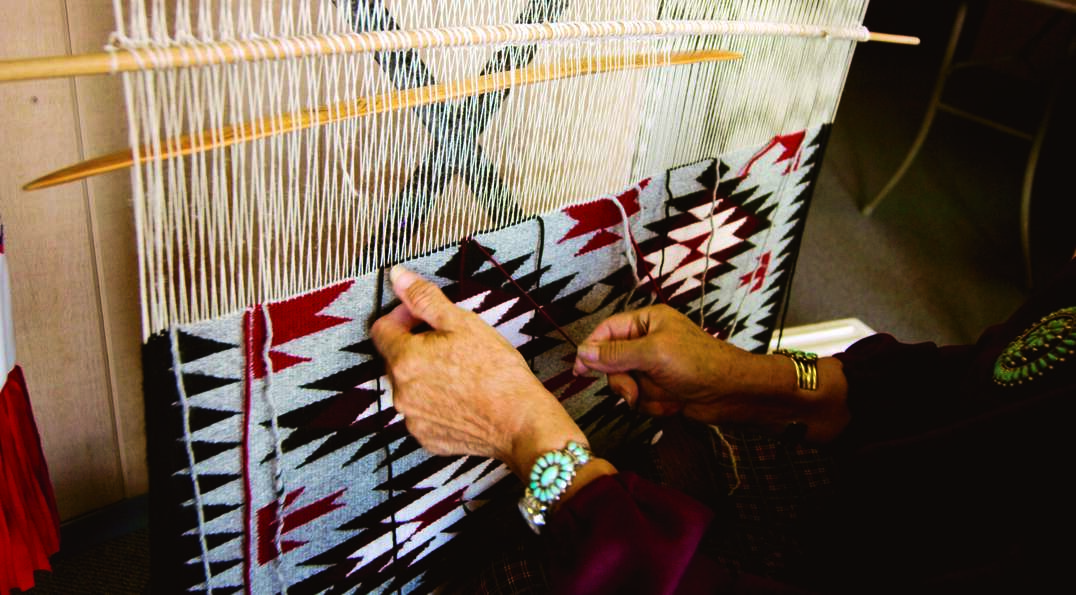
Weaving a Navajo blanket.
Walking in Beauty
Hózhó is a Navajo word that means walking in beauty or living in a manner that strives to create and maintain balance, harmony, beauty and order. “We’ve learned a lot from being there,” says Deb. “We know how to show our respect and understanding for their lives and culture and how to honor it. If you’re willing to learn, they will teach you.”
“We want to help them succeed in whatever they want to do with their lives,” says Melissa. “If they choose to live on the reservation, we can help them to do so to the best of their ability — that’s all we can hope for. We want them to know that there are people who care about them without changing the essence of who they are.”
Their spirituality is beautiful, says Deb. They are equal with each other, animals and plants. We understand and share the glory of nature — Mother Earth and Father Sky — with them, and we are thankful for this beautiful world we live in,” she says. “We have fallen in love with this Road Scholar experience.”
Melissa and Deb agree that volunteering at the Navajo schools and spending time with the children is one of the best things they’ve ever done. “We are grateful to Road Scholar for offering us this opportunity,” says Deb. “It’s an exceptional program — kudos to Road Scholar! I don’t know who came up with this idea, but oh my,” says Melissa.
A Rare Opportunity
Lisa C. from Illinois traveled solo with Road Scholar, drawn by the opportunity to take part in a meaningful, hand-on learning experience within the Navajo Nation. “It’s a great program and the only program I could find was with Road Scholar.”
Lisa enjoyed helping the fourth and fifth graders with their homework and getting them ready for the next day. “They love the one-on-one attention.”
Why Road Scholars Return
“Our Road Scholar volunteers return for different reasons,” says Tracy. “Some want to give back and some want to bring attention to the reservation and talk about the unfiltered version of American history that was swept under the rug.” Most volunteers see there is a real need. For Melissa and Deb, it was the children. “The children and the Navajo community were so warm during our first program that we knew we would be back to help again,” says Deb.
The demand for volunteer opportunities is greater than we can accommodate,” says Tracy. “Our schools are small and we don’t want to overwhelm them. It’s a labor of love,” she says.
Lisa is planning her third Road Scholar program because she wants to give her time and effort to this particular community — yet she acknowledges that she benefits as well. “After spending time with the children, I feel like they gave everything to me. It all comes back to me, tenfold. That’s what it’s about,” she says. She adds, “Tracy is the most wonderful person. We learn something new every time.”
Susan O. from California has returned to the program 15 times since 2008, drawn by the depth of learning and opportunity to contribute meaningfully in Navajo Nation schools.
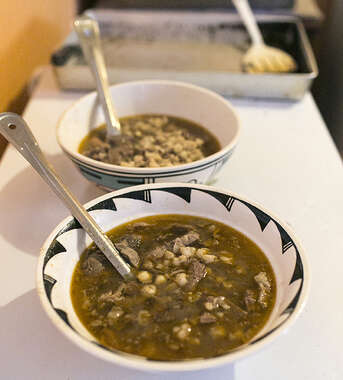
Traditional Navajo stews.